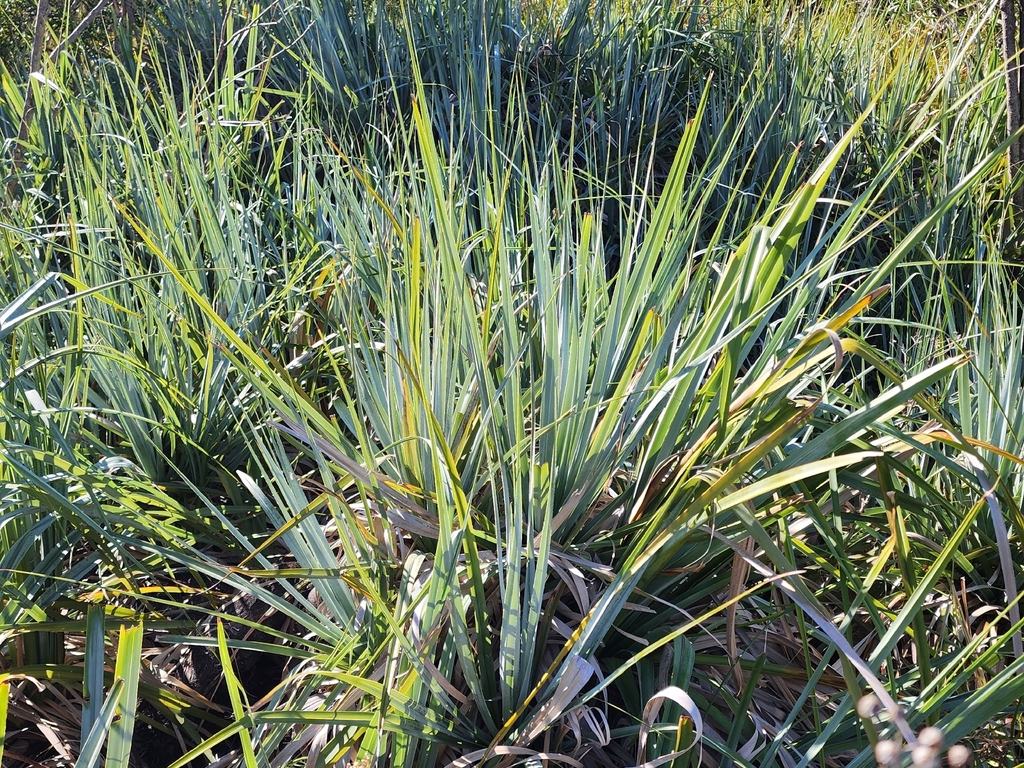
Flora Detail
| Common Name | Palmiet |
| Family | Thurniaceae |
| Date Observed | 25-04-2025 |
| Category | Grasses |
|---|---|
| Catalogue No. | 2226RG |
| Flowering Time | Spring,Summer |
| Colour | Brown |
| Locations Observed | |
| Estuary | Many |
| Koppie | Not Observed |
| Nature Reserve | Not Observed |
| Small Holding | Many |
| Village | Not Observed |
| Greater Rooiels | Many |
Prionium serratum
Information
Palmiet

PRIONIUM SERRATUM
Family: Juncaceae
Common names: Palmiet (Eng.); (Wilde) palmiet (Afr.)
NOT PRETTY, BUT VERY PRACTICAL
Prionium serratum, or palmiet, is a water-loving shrub. It may not be the prettiest plant in the fynbos, but it has some serious practical attributes.
We have the Palmiet River near Kleinmond, where great stands of it grow, but we also have plenty of palmiet right here in Rooiels.
DESCRIPTION
Palmiet grows up to about two metres tall. The stems are covered with the dark brown, fibrous remains of old leaves, while the living leaves are pale grey-green, stiff and have sharply toothed edges.
Trying to negotiate your way through a dense stand is not recommended. Those saw-edged leaves can cut your hands and body — palmiet is definitely best admired from a little distance!
DISTRIBUTION & HABITAT
Palmiet occurs from the Western Cape eastwards to southern KwaZulu-Natal. It is a plant of wet places, growing in marshes, streams and rivers.
In Rooiels, we find it all along the Rooiels River, growing on the banks and on sandbanks in the river itself. There are also dense stands in the estuary, where they provide valuable shelter and habitat.
WHAT'S IN A NAME?
The name Prionium comes from the Greek prion, meaning saw, a reference to those formidable leaf blades. Serratum means serrated or saw-toothed, again referring to the toothed edges of the leaves.
The common name palmiet has a long history in South Africa and was already in use during the time of Jan van Riebeeck.
BUILT FOR FIRE
Palmiet is fire-resistant and can resprout vigorously after a fire. Even when the vegetation above ground is burnt, established plants are able to recover.
NATURE'S RIVER ENGINEER
This is where palmiet really earns its keep.
Its dense growth and extensive root system help stabilise riverbeds and riverbanks, binding the soil and reducing erosion. Dense palmiet wetlands can also influence the way water moves through a river system.
So that rather untidy-looking mass of vegetation beside the river is actually performing an important job — helping to hold the river landscape together.
USES
Palmiet has also been useful to people. The young flower shoots have traditionally been eaten as a vegetable, while the tough leaves have been used for basketry, hats and mats.
Conservation status: Least Concern.