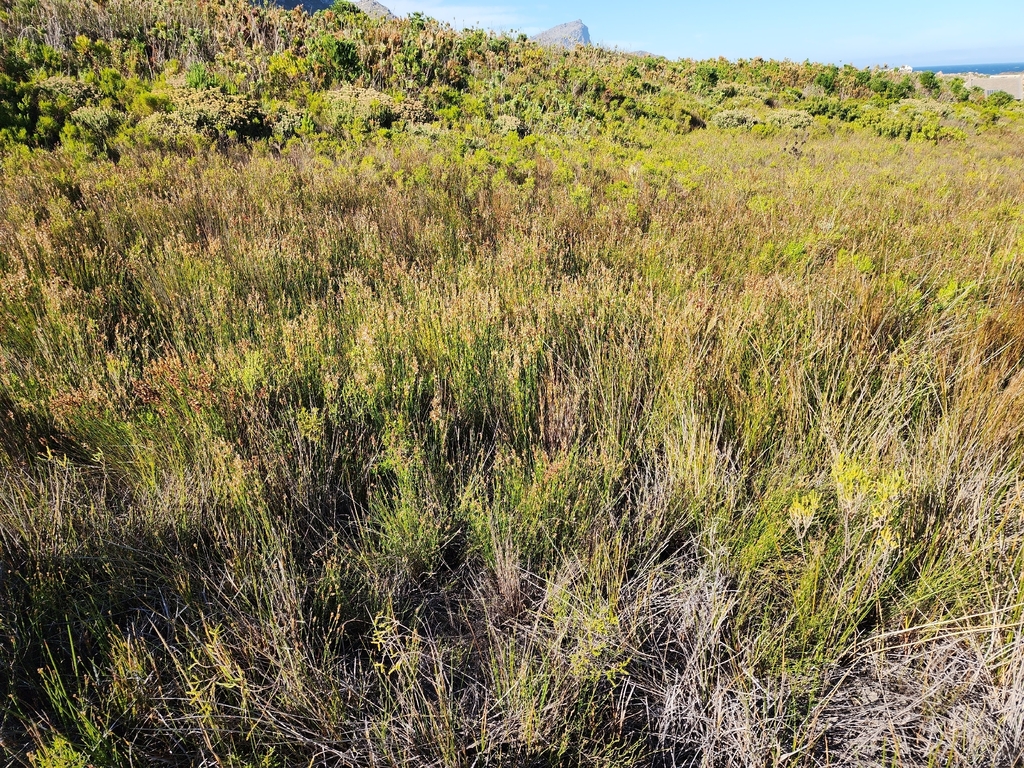
Flora Detail
| Common Name | Cushion restio |
| Family | Restionaceae (Capereeds) |
| Date Observed | 25-04-2026 |
| Category | Grasses |
|---|---|
| Catalogue No. | 2229RG |
| Flowering Time | Summer,Autumn |
| Colour | Brown |
| Locations Observed | |
| Estuary | Not Observed |
| Koppie | Many |
| Nature Reserve | Many |
| Small Holding | Many |
| Village | Many |
| Greater Rooiels | Many |
Elegia stipularis
Information
Cushion restio

ELEGIA STIPULARIS
Family: Restionaceae
Common name: Cushion Restio
WAVING IN THE ROOIELS WIND
You must have seen this cushion restio. There are many in
the Rooiels Reserve and surrounding areas. We also find them on Klein-Hangklip,
while vast populations grow on Rooiels Mountain.
Waving in the wind, their overall appearance is elegant and
mesmerising, creating movement across the landscape against the lower mountain
slopes — a delight for fynbos lovers.
DESCRIPTION
Elegia stipularis is a compact, tufted restio that
can grow up to about one metre tall.
The sheaths are tan, with reddish-brown speckles and tan
margins. Male and female flowers occur on separate plants and appear during
June and July.
The brown fruits are papery to leathery and are not winged.
WHERE DOES IT GROW?
This restio is common on well-drained slopes, where it can
form dense stands. Unlike some other restios, it is not found in seepages or
wet places. It prefers deeper sandy soils and sandstone slopes.
Sometimes we look across a lower mountain slope covered in
restios and see a strip of Leucadendron meandering down through them.
Why is that?
The Leucadendron enjoys the seepage.
The cushion restio doesn't.
Suddenly the plants are telling us something about the
mountain beneath our feet.
WIND, SEEDS AND FIRE
Restios are wind-pollinated. Walking in the fynbos, one
sometimes sees little puffs of pollen suddenly flying into the air. They may
come from various plants — and our Elegia stipularis is one of them.
Female plants have large, prominent sheaths that help funnel
wind-borne pollen onto the stigmas.
The seeds are released before the next flush of flowers and
are stored in the upper layer of the soil.
Fire brings dramatic change. The mature plants are killed,
but fire and smoke stimulate seeds lying in the soil to germinate. These
seedlings then become the next generation of cushion restios.
We have observed stunning displays in the Kogelberg Nature
Reserve after fire. Growing faster than many of the surrounding plants, the
young restios can dominate the recovering landscape. Suddenly one comes across
a spectacular field of reddish-golden cushion restios.
IN THE GARDEN
Elegia stipularis is fairly fast-growing and makes an
attractive garden plant. It does particularly well in groups, where its
graceful movement and seasonal colours can make a wonderful display.
Conservation status: Not threatened.